Understanding the Current SSB Selection Process
SSB Process Changed ? SSB Computerised Stage-1 Major Updates. The SSB interview has long been considered one of the toughest personality-based selection systems in India.
Designed to assess whether a candidate possesses the qualities required to become an officer in the armed forces, the process is not just about intelligence—it’s about personality, leadership, and decision-making under pressure. The SSB interview spans five days, and every day is proper structured to evaluate candidates from all possibilities.
The SSB process is divided into two major stages. Stage-1 acts as a screening filter, while Stage-2 dives deeper into personality evaluation. What makes this system unique is its scientific approach—candidates are observed in different situations rather than judged based on a single test. This ensures a holistic evaluation, something that traditional exams fail to achieve.
The selection rate in SSB is quite low—only about 6–10% of candidates make it, which shows how selective and refined the process is. This isn’t just an exam; it’s more like a personality audit. And now, with talks of computerisation, many aspirants are wondering: is this system about to change completely?
Stage-1 Screening Overview
Stage-1 is the gateway to the SSB process. Think of it as the first filter that decides whether you move forward or head back home the same day. This stage includes two key tests: the Officer Intelligence Rating (OIR) and the Picture Perception and Discussion Test (PPDT).
The OIR test evaluates logical reasoning and mental ability, while the PPDT assesses how you perceive situations, structure thoughts, and communicate in a group. However, this stage has always had one major limitation—time constraint. Candidates get very limited time to express themselves, and sometimes even deserving candidates get screened out simply because they couldn’t perform under pressure in those few minutes.
Imagine trying to tell your best story in under one minute while competing with 10 others—that’s exactly what PPDT feels like. This limitation is one of the primary reasons why authorities are now exploring improvements.
Stage-2 Detailed Assessment
Once a candidate clears Stage-1, they enter the real battlefield—Stage-2. This stage includes psychological tests, GTO tasks, personal interviews, and the final conference. Over four days, assessors observe candidates in different scenarios to evaluate their Officer-Like Qualities (OLQs).
These qualities include leadership, teamwork, emotional stability, and decision-making ability. What’s fascinating is that the same trait is evaluated in multiple ways. For example, your leadership might be tested in a group task, cross-verified in an interview, and analyzed again through psychological tests.
This layered evaluation ensures that no candidate can fake their personality. And this is exactly why SSB has remained reliable for decades. Even with technological upgrades, this core philosophy is unlikely to change.

Why Is There Talk About Changes in SSB?
If the SSB process is already so effective, why change it? That’s the big question. The answer lies in evolving requirements. Today’s military officers operate in a technology-driven, fast-paced environment, and the selection system needs to reflect that reality.
Additionally, feedback from candidates over the years has pointed out certain inefficiencies in Stage-1 screening. The biggest concern has been the lack of sufficient evaluation time, especially during group discussions.
Limitations of Traditional Screening – SSB Process Changed
The traditional Stage-1 system relies heavily on quick observation. While this works for many candidates, it may not always capture the full potential of an individual. For instance, a candidate who is slightly nervous initially might perform exceptionally well in later stages—but they never get that chance if screened out early.
Another limitation is subjectivity. While assessors are highly trained, human judgment can sometimes be influenced by group dynamics, dominant speakers, or communication styles. This creates a need for a more objective, data-driven approach.
Need for Modern Evaluation Systems – SSB Process Changed
In a world where everything is becoming digital, from exams to job interviews, it makes sense for SSB to explore computerised methods as well. A computer-based system can assess multiple parameters simultaneously—speed, accuracy, memory, and behavioral patterns.
This doesn’t mean replacing human judgment but enhancing it. Think of it like using GPS while driving—you still control the car, but the system helps you make better decisions. SSB Process Change ?
What Is the Computerised Stage-1 Selection System (CSSS)?
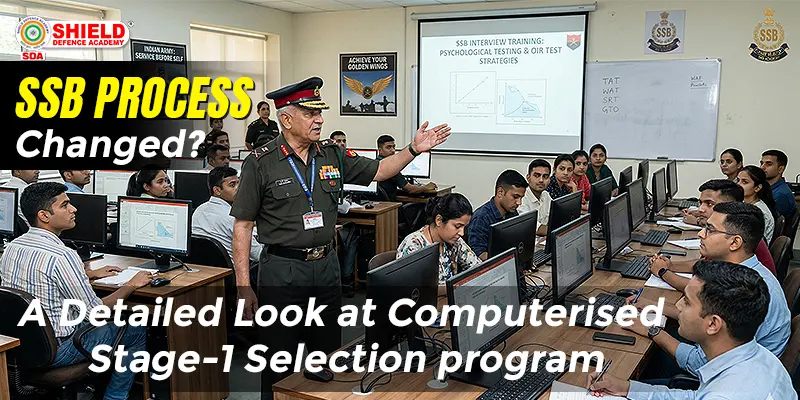
The Computerised Stage-1 Selection System (CSSS) is a proposed upgrade to the traditional screening process. It aims to make Stage-1 more structured, objective, and comprehensive by introducing computer-based tests.
Core Concept of CSSS
Instead of relying solely on OIR and PPDT, CSSS introduces a multi-dimensional assessment. Candidates may be required to answer around 190 questions, covering both cognitive abilities and personality traits.
The idea is simple: gather more data about each candidate in a short period. This allows assessors to make better-informed decisions rather than relying on limited interaction.
Is It Officially Implemented Yet? SSB Process Changed
As of now, the system is still in the discussion and testing phase, and there has been no official nationwide implementation. This means candidates preparing for SSB should not panic—the current system is still valid.
However, early trials and discussions suggest that such a system could be introduced in the near future once infrastructure and validation are complete.
Structure of the Computerised Screening Test
The proposed CSSS is divided into two main sections: cognitive ability and personality assessment. Best NDA Coaching in Lucknow
Cognitive Ability Section – SSB Process Changed
This section focuses on how fast and accurately a candidate processes information. Around 70 questions may test various mental abilities.
Types of Cognitive Tests
These may include:
- Pattern recognition
- Spatial reasoning
- Memory-based tasks
- Auditory processing tests
- Attention and reaction-based tasks
These tests are designed to simulate real-life decision-making scenarios where quick thinking is crucial.
Personality Assessment Section
The second section includes around 120 questions focused on personality traits. Instead of writing long answers, candidates select options like “Agree” or “Disagree.”
Situational Judgment Questions
Candidates may be presented with real-life scenarios and asked how they would react. This helps assess integrity, leadership, and ethical thinking—qualities that cannot be judged through reasoning tests alone.
Key Differences: Traditional vs Computerised SSB Stage-1
| Feature | Traditional Stage-1 | Computerised Stage-1 |
|---|---|---|
| Mode | Paper + Group Discussion | Computer-Based |
| Evaluation | Limited interaction | Data-driven analysis |
| Time | Very short | Structured |
| Objectivity | Moderate | High |
| Parameters | OIR + PPDT | Cognitive + Personality |
Advantages of Computerised Screening – SSB Process Changed
The biggest advantage of CSSS is fairness. Every candidate gets equal time and equal opportunity to perform. No more being overshadowed in group discussions.
It also allows for faster result processing, reducing waiting time and increasing efficiency. Additionally, the system generates large amounts of data, which can be used to refine the selection process over time.
Challenges and Concerns – SSB Process Changed
Despite its advantages, the system is not without challenges. One major concern is over-reliance on technology. Can a computer truly assess leadership? Probably not entirely.
There’s also the issue of accessibility. Not all candidates may be equally comfortable with computers, especially those from rural backgrounds. SSB Process Change ?
Impact on SSB Aspirants – SSB Process Changed
For aspirants, this change means one thing: adaptability. The focus will shift from just communication skills to overall cognitive and behavioral performance.
Candidates will need to prepare for aptitude tests, memory exercises, and situational judgment scenarios, in addition to traditional SSB preparation.
Preparation Strategy for New Pattern – SSB Process Changed
If CSSS is implemented, preparation should include:
- Practicing online aptitude tests
- Improving reaction time and memory
- Developing honest personality responses
- Strengthening decision-making skills
The key is balance—you can’t fake personality, but you can definitely sharpen your thinking ability.
Reality Check: Is SSB Process Changed
No, the SSB process is not completely changing. The core objective remains the same—selecting candidates with Officer-Like Qualities.
CSSS is more like an upgrade, not a replacement. The human element—psychologists, GTOs, and interviewers—will always remain central to the process.
Future of SSB Selection System
The future of SSB lies in a hybrid model—technology + human judgment. This combination can make the process more efficient, fair, and aligned with modern military requirements.
Conclusion – SSB Process Changed
The buzz around SSB changes has created confusion, but the reality is much simpler. The Computerised Stage-1 Selection System is an evolution, not a revolution. It aims to enhance fairness, improve accuracy, and bring the selection process in line with modern standards.
For aspirants, the message is clear: focus on developing your personality, sharpen your cognitive skills, and stay adaptable. Because no matter how the process changes, Officer-Like Qualities will always remain the key to success. SSB Process Change ?
FAQs
1. Is the SSB process completely changed?
No, only improvements in Stage-1 screening are being considered.
2. What is CSSS in SSB?
It is a proposed computerised screening system for Stage-1 evaluation.
3. Will PPDT be removed?
There is no official confirmation; it may still remain part of the process.
4. Is computer knowledge required?
Basic familiarity is enough; advanced skills are not needed.
5. When will CSSS be implemented?
No official date yet; it is still under testing and evaluation.
6. Which coaching is best for SSB Preparation ?
No doubt , Shield defence academy based in Indira Nagar is best defence coaching in Lucknow.