What is the GTO in SSB?
Conquering the GTO Test in SSB: A Comprehensive Guide – If you’ve ever dreamed of wearing the uniform and leading from the front, the GTO (Group Testing Officer) test is where your personality gets tested in the most practical way possible. Unlike written exams or interviews where you can prepare answers, the GTO phase is raw, dynamic, and brutally honest. It’s conducted over two days during the SSB process and focuses heavily on how you behave in real-life-like group situations.
Think of it this way—this is not a test of knowledge; it’s a test of you. How you think, how you act, how you respond when things don’t go as planned. The assessors are experienced officers who observe your behavior continuously, often without giving you any direct feedback.
The tasks are designed to simulate military scenarios where teamwork, quick thinking, and leadership are critical. You’re not expected to be perfect, but you are expected to be genuine, proactive, and effective under pressure. That’s what makes the GTO round both exciting and intimidating at the same time.
In essence, the GTO isn’t looking for superheroes. They’re looking for reliable, trainable individuals who can become officers. And that’s a big difference many candidates fail to understand.
Why GTO Tasks Matter in Officer Selection
You might be wondering—why so much emphasis on these physical and group activities? The answer is simple: battlefields don’t care about theory. The armed forces need leaders who can act, not just think.
GTO tasks are specifically designed to evaluate your Officer Like Qualities (OLQs) such as leadership, cooperation, initiative, courage, and decision-making. These are not traits you can fake consistently over two days of intense observation.
Imagine being in a real-life emergency where your team depends on you. Will you panic, stay silent, or step up? That’s exactly what these tasks try to uncover. Whether it’s solving a group obstacle or leading a command task, every action you take reflects your potential as an officer.
Another important aspect is consistency. The GTO compares your behavior with your performance in psychological tests and personal interviews. If there’s a mismatch—say you claim to be a leader but stay quiet in group tasks—it becomes a red flag.
So, the importance of GTO tasks goes beyond just “clearing a stage.” It’s about proving that you are someone who can be trusted with responsibility, lives, and leadership in challenging environments.
Overview of All GTO Tasks – GTO test in SSB
List of 9 GTO Tasks
The GTO series includes a total of nine carefully structured tasks, each designed to evaluate different aspects of your personality.
Here’s a quick breakdown:
| Task | Purpose |
|---|---|
| Group Discussion (GD) | Communication & awareness |
| Group Planning Exercise (GPE) | Problem-solving |
| Progressive Group Task (PGT) | Teamwork & logic |
| Half Group Task (HGT) | Leadership in smaller teams |
| Group Obstacle Race | Team spirit & energy |
| Lecturette | Confidence & clarity |
| Individual Obstacles | Physical fitness |
| Command Task | Leadership under pressure |
| Final Group Task (FGT) | Overall teamwork |
Each task adds a new layer to your evaluation. It’s like peeling an onion—by the end, the assessors have a complete picture of who you are.
Indoor vs Outdoor Tasks – GTO test in SSB
Understanding the nature of tasks gives you a strategic advantage. Broadly, GTO tasks are divided into indoor and outdoor categories.
Indoor tasks like GD, GPE, and Lecturette focus more on your communication, awareness, and thinking ability. These are relatively less physically demanding but require clarity of thought and confidence in expression.
Outdoor tasks, on the other hand, such as PGT, HGT, Snake Race, and Individual Obstacles, test your physical stamina, teamwork, and practical intelligence. These are where candidates often feel the heat—literally and figuratively.
Balancing both is crucial. Being physically strong but poor in communication—or vice versa—won’t help. The ideal candidate performs consistently across both domains, showing adaptability and balance.
Deep Dive into Each GTO Task
Group Discussion (GD) – GTO test in SSB
The GD is often the first impression you create in the GTO phase, and it sets the tone for everything that follows. Usually, two topics are given—one current affairs-based and another abstract.
This isn’t your typical debate competition. There’s no moderator, no fixed structure, and no marks for speaking the most. The real challenge is to contribute meaningfully while maintaining group harmony.
Many candidates make the mistake of trying to dominate the discussion. But here’s the truth—officers lead, they don’t shout. You need to present your points clearly, listen actively, and build on others’ ideas.
A good GD performance feels like a conversation, not a battlefield. If you can guide the discussion subtly and help the group reach a conclusion, you’re already ahead of most candidates.
Group Planning Exercise (GPE)
Imagine being given a complex real-life problem involving multiple emergencies—accidents, deadlines, limited resources—and being asked to solve it with your group. That’s exactly what GPE is.
You first analyze the situation individually, then discuss it with the group, and finally present a common solution. This task tests your prioritization, logical thinking, and teamwork.
The key here is structure. Break the problem into parts, assign priorities, and propose realistic solutions. Avoid unrealistic heroics like “I’ll do everything alone”—that’s not what the assessors want.
What impresses the GTO is a balanced approach—clear thinking combined with practical execution and teamwork.
Progressive Group Task (PGT)
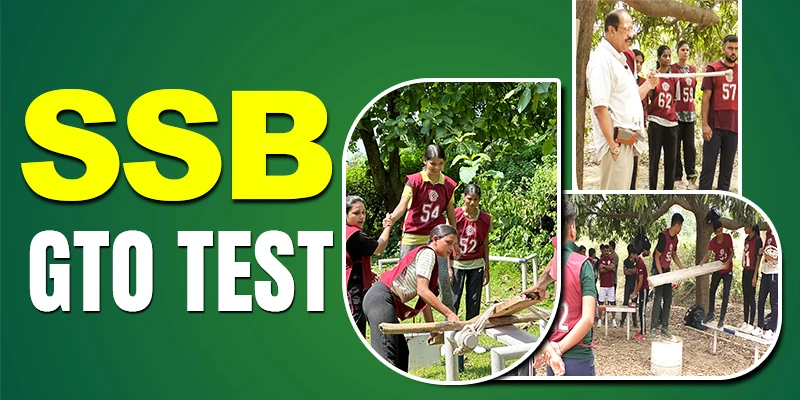
This is where things start getting physically interesting. You and your group are given obstacles along with helping materials like planks and ropes. The goal is to cross these obstacles following certain rules.
As the name suggests, the difficulty increases progressively.
Here’s the catch—it’s not about who crosses first. It’s about how the group works together. Suggest ideas, help others, and stay involved.
Candidates who jump ahead alone or stay passive often get ignored. The ideal approach is to actively participate, give workable suggestions, and support your team throughout.
Half Group Task (HGT)
HGT is similar to PGT but with a smaller group. This gives you more opportunities to participate and showcase your abilities.
With fewer members, your contribution becomes more visible. If you were quiet earlier, this is your chance to step up.
Think of it as a second innings—you can correct mistakes and improve your performance.
Group Obstacle Race (Snake Race) – GTO test in SSB
This is the most energetic and fun task in the GTO series. Teams compete against each other while carrying a “snake” (a rolled tent).
It tests your team spirit, enthusiasm, and coordination. Shouting war cries, encouraging teammates, and maintaining energy levels are all part of the game.
Don’t hold back here. The GTO wants to see your josh (energy) and your ability to uplift the team.
Lecturette
You’ll be given a few topics and asked to speak for 3–4 minutes.
This task evaluates your confidence, clarity, and communication skills. You don’t need to be a subject expert. What matters is how you present your thoughts.
Structure your talk—introduction, body, conclusion—and speak naturally. Even if you make a mistake, continue confidently.
Individual Obstacles
This is your moment to shine individually. You’ll face multiple obstacles with different difficulty levels, each carrying points.
This task tests your physical fitness, courage, and determination.
Even if you can’t complete all obstacles, your effort and attitude matter. Keep trying, stay energetic, and don’t give up midway.
Command Task
Here, you become the leader. You’re given a task and allowed to choose team members to help you complete it.
This is where your leadership style is evaluated. Can you give clear instructions? listen to suggestions? Can you stay calm under pressure?
Avoid being bossy or confused. Be clear, confident, and inclusive.
Final Group Task (FGT)
The last task is like a grand finale. It’s similar to PGT but with the entire group working together again.
By now, the GTO has already formed an opinion about you. This task is your chance to reinforce that impression.
Stay consistent, stay involved, and finish strong.
Officer Like Qualities (OLQs) Assessed – GTO test in SSB
Key Traits Evaluated
The GTO is constantly evaluating traits like:
- Leadership
- Initiative
- Cooperation
- Courage
- Decision-making
These are not just buzzwords—they’re the foundation of military leadership.
Behavioral Indicators
What’s interesting is that the GTO doesn’t rely on what you say, but on what you do. Small actions—helping a teammate, giving a practical idea, staying calm—speak louder than words.
Consistency across tasks is what builds a strong recommendation.
Proven Strategies to Crack GTO Tasks – GTO test in SSB
Communication Mastery
Clear communication is your biggest weapon. Speak confidently, but also listen actively. Good communicators are not the loudest—they’re the most effective.
Leadership Without Dominance
Leadership in GTO is subtle. Guide the group, don’t control it. Influence matters more than authority.
Teamwork and Cooperation – GTO test in SSB
Remember, you’re being tested as a team player, not a solo performer. Help others succeed, and you’ll stand out naturally.
Common Mistakes Candidates Make – GTO test in SSB
Overacting and Artificial Behavior
Trying to act like an “ideal officer” often backfires. Be natural. Authenticity is your biggest strength.
Lack of Participation
Staying silent is just as harmful as over-dominating. Find the balance.
Physical and Mental Preparation Tips
Fitness Requirements – GTO test in SSB
You don’t need to be an athlete, but basic fitness is essential. Focus on stamina, agility, and strength.
Mental Conditioning – GTO test in SSB
Stay calm under pressure. Practice visualization and problem-solving.
Latest Trends in GTO Evaluation (2025–2026)
Recent trends show a stronger focus on authentic behavior, teamwork, and stress handling rather than just physical performance.
The shift reflects modern military needs—adaptability and emotional intelligence are now as important as strength.
Final Day Tips for GTO Success
Stay consistent. Don’t try to suddenly change your personality. Trust your preparation and give your best in every task.
Conclusion – GTO test in SSB
Cracking the GTO test isn’t about tricks or shortcuts—it’s about becoming the kind of person the armed forces are looking for. When you focus on genuine improvement rather than superficial performance, success follows naturally.
Think of GTO as a mirror. It reflects who you truly are. If you like what you see, chances are, the assessors will too.
FAQs – GTO test in SSB
1. How many GTO tasks are there in SSB?
There are nine GTO tasks designed to evaluate different aspects of a candidate’s personality.
2. Is physical fitness very important for GTO?
Yes, but only to a basic level. More important is your teamwork and mindset.
3. Can introverts perform well in GTO?
Absolutely. You don’t need to be loud—just clear, confident, and consistent.
4. What is the toughest GTO task?
It varies, but many candidates find Command Task and PGT challenging due to decision-making pressure.
5. How can I improve my GTO performance quickly?
Practice group discussions, improve fitness, and focus on real-life problem-solving skills.